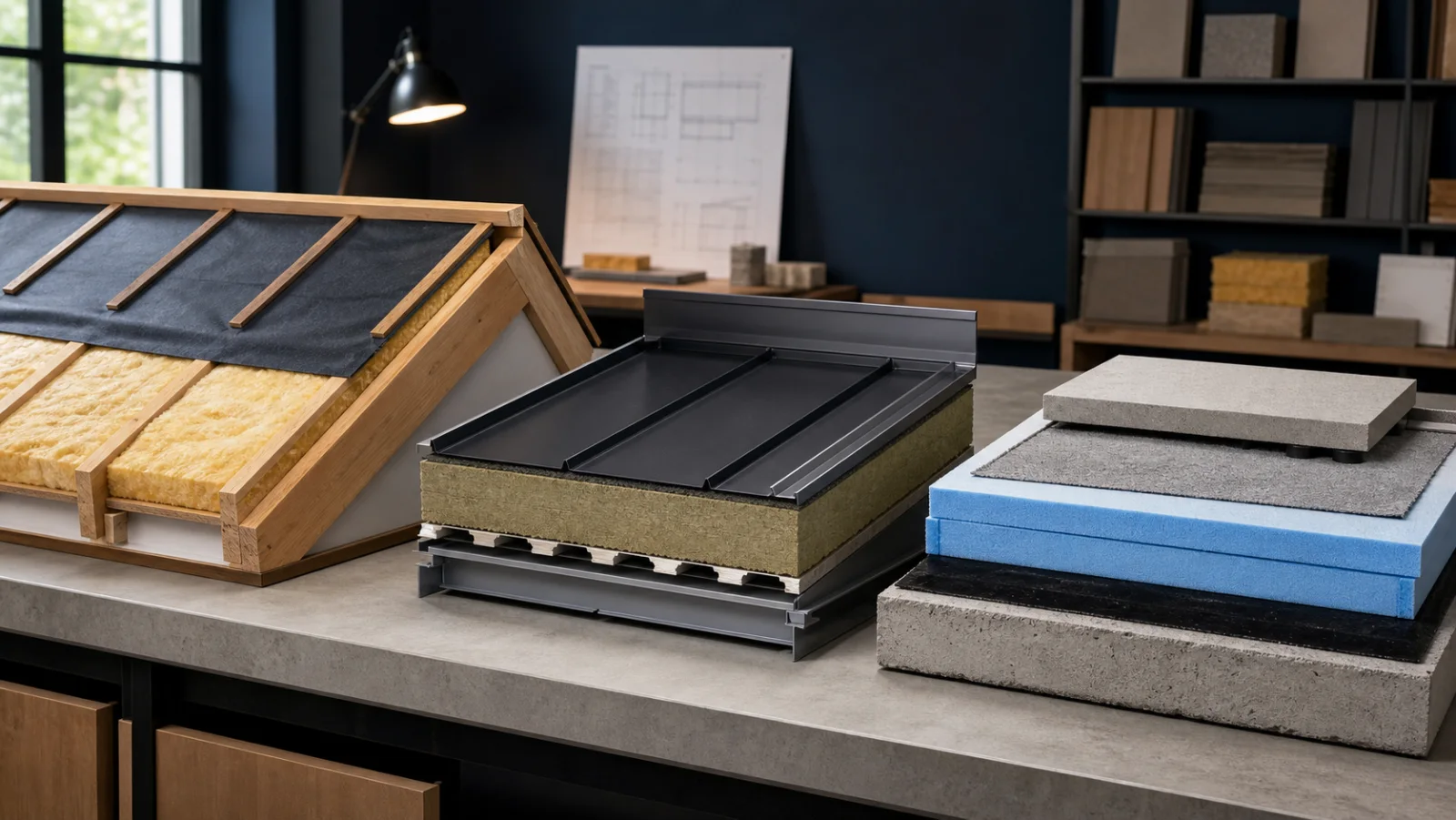
Roof insulation materials are selected according to roof type, imposed loads and layer sequence. Glass wool blankets laid over an unused loft floor, rigid stone wool boards in metal roofs and XPS above waterproofing in inverted roofs fulfil the same thermal role under different conditions.
It is therefore inappropriate to answer “glass wool, stone wool or XPS for my roof?” without knowing the roof type. First define the heated-space boundary, whether the roof is pitched or flat and walkable, waterproofing position and condensation risk.
Roof Insulation Involves Three Separate Roles
Thermal insulation, waterproofing and vapour control are not interchangeable layers:
- Thermal insulation: Restricts heat flow between indoors and outdoors. Glass wool, stone wool and XPS are different product families used for this role.
- Waterproofing or roof underlay: Prevents rain and external water reaching the structure and thermal insulation. A flat-roof membrane and a breathable pitched-roof underlay are different details.
- Air and vapour control: Reduces uncontrolled movement of indoor air and water vapour into the roof assembly. Position is determined by roof type and condensation calculations.
Thick thermal insulation alone cannot compensate for faulty water or vapour details. Similarly, a waterproof membrane alone does not solve heat loss. Review all product groups together on the roof insulation solutions page.
Comparing Glass Wool, Stone Wool and XPS
| Material | Key roof applications | Strength | Points to watch |
|---|---|---|---|
| Glass wool | Unused lofts, between rafters and unloaded horizontal surfaces | Lightweight, flexible, easy large-area laying and good thermal performance | Do not walk on or compress it; protect it from moisture |
| Stone wool | Conventional flat roofs, metal roofs and systems prioritising fire/acoustic performance | Mechanical strength in dedicated rigid roof products, mineral structure and sound control | Select a roof product rather than partition or external wall insulation boards |
| XPS | Above membranes in inverted flat roofs; suitable products above rafters on pitched roofs | Low water absorption, closed cells and high compressive strength | Check fire class, UV protection, separating layers and suitability for the roof type |
1. Which Material Is Used in an Unused Loft?
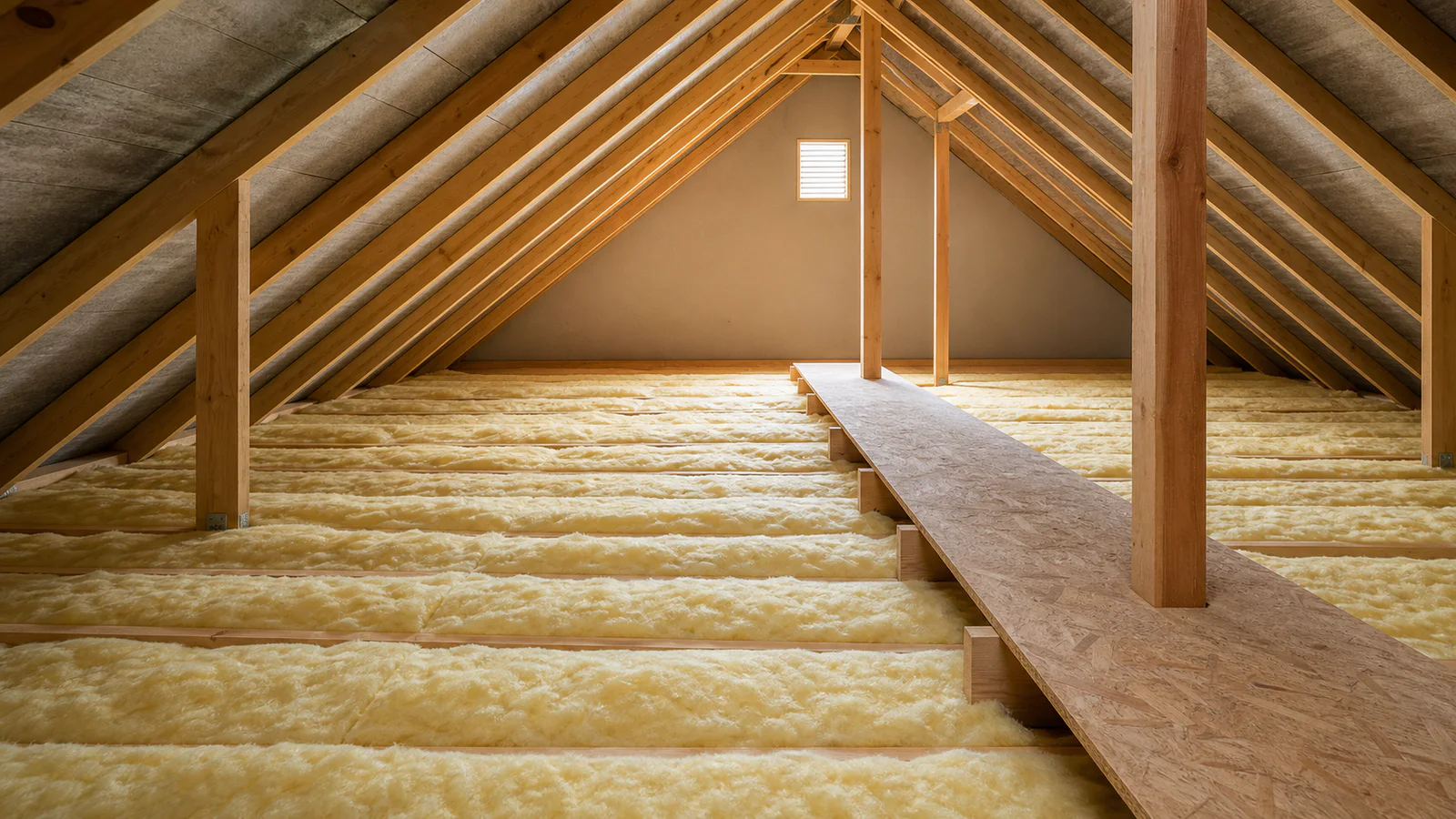
If the loft is unused and the heated space ends beneath the top-floor ceiling, the thermal boundary usually lies on the loft floor. Lightweight rolls such as İzocam Roof Blanket can be laid easily over this large area.
İzocam defines its glass wool Roof Blanket for floors of unused lofts, between rafters in occupied attics and unloaded horizontal applications. Do not store objects or walk on the installed product. Where a loft is used for storage, design walkways on independent supports that do not crush insulation.
Install blankets without gaps, with staggered joints, and keep eaves ventilation and designed air paths open. Arbitrarily laying polyethylene over the cold side can cause indoor vapour to condense there and wet the material. Resolve vapour control on the warm side according to the design calculation.
2. How Are Materials Selected for an Occupied Pitched Roof?
When an attic becomes living space, insulation may sit between, beneath or above the rafters in the sloping roof plane. Flexible glass wool or suitable mineral wool makes it easier to fill between rafters. Cut boards or blankets to the framing spacing, without air gaps or excessive compression.
Timber rafters are thermal bridges. Rather than insulating only between them, a continuous second layer below or above can improve performance where calculations and roof height permit. Tape joints and service penetrations in the internal air/vapour control layer; externally, provide suitable vapour-permeable water-resistant underlay and covering details.
Can XPS be used on a pitched roof?
İzocam Foamboard 1500 is an XPS board developed by its manufacturer for over-rafter pitched-roof systems. Board edges must fit fully together, counter-battens must be fixed to rafters and vapour-permeable underlay above the XPS must have correct overlaps.
This does not mean any XPS board can be arbitrarily squeezed between rafters. Assess edge profiles, mechanical strength, fire class, covering and fixing method within the complete system.
3. Where Is Stone Wool Used in Conventional Flat Roofs?
In conventional or warm flat roofs, thermal insulation lies beneath the waterproofing according to system design. Stone wool here must be a dedicated rigid roof board able to support overlying layers and installation loads. Flat Roof Board is the product group considered for this purpose.
Stone wool roof boards contribute thermal and sound insulation and fire safety, but do not replace waterproofing. Design vapour control, falls, boards, waterproofing and protection/finish together to the manufacturer's detail. Resolve outlets, parapets, door thresholds and expansion joints before the main surface.
Many stone wool products may share a thickness. Manto Stone Wool or Partition Board must not replace a roof board manufactured for the roof's loads and surface requirements.
4. Why Is XPS Preferred in Inverted Flat Roofs?
In an inverted roof, the waterproofing membrane is closer to the structure, with XPS above it. Since insulation is nearer rain, freeze-thaw exposure and service loads, low water absorption and adequate compressive strength are important.
Roof-appropriate XPS can be loose-laid above waterproofing with fully closed joints. Depending on the membrane, a compatible separating layer sits between them; filter/geotextile and gravel, paving slabs or a flooring system sit above XPS according to use. Plan parapet turn-ups and outlet levels for the total layer thickness.
Stone wool in a conventional roof and XPS in an inverted roof do not occupy the same position. Ignoring this distinction can produce a faulty roof system even with the correct material.
5. Which Insulation Is Used in Metal Roofs?
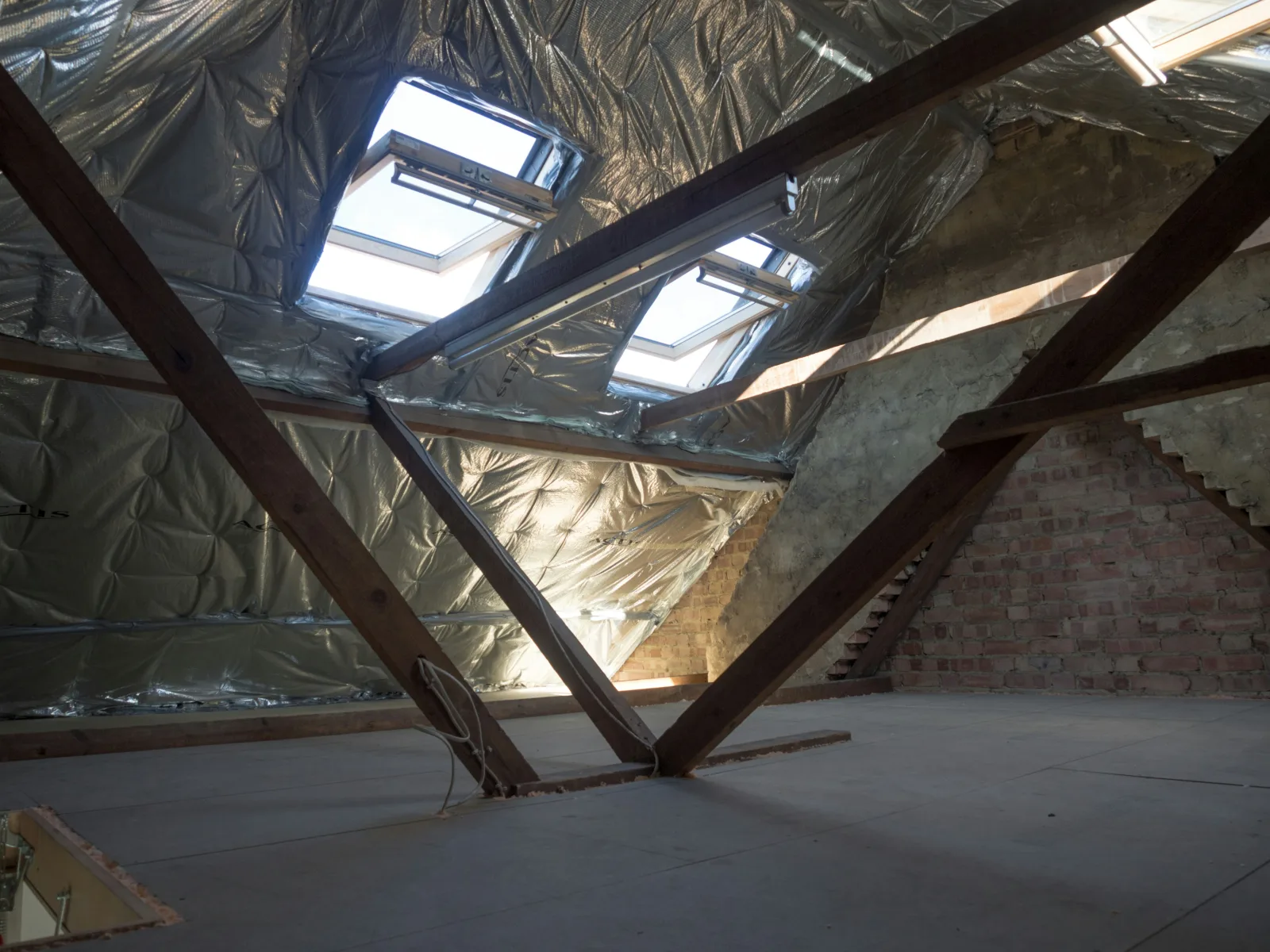
Metal roofs heat quickly in sunlight, cool rapidly at night and can develop internal condensation. Site-built double-metal systems can use mineral wool boards with the required compressive and fire performance. Stone wool stands out in industrial buildings with high fire and acoustic demands; glass wool in roof-appropriate board or blanket form can offer a lightweight solution.
Simply placing insulation beneath metal covering is insufficient. Design internal air/vapour control, external water removal or condensate drainage, joint sealing, thermal bridges at fixings and fire details together. Product selection must match operating temperatures and span/load calculations.
Material Selection Matrix by Roof Type
| Roof type | Primary thermal insulation option | Main check point |
|---|---|---|
| Unused cold loft | Glass wool roof blanket on an unloaded floor | Gap-free laying, no compression, air and vapour control |
| Occupied pitched roof | Mineral wool between rafters; over-rafter XPS in suitable systems | Thermal bridges, continuous second layer, breathable external underlay |
| Conventional flat roof | Rigid stone wool roof board of the appropriate load class | Vapour control, falls and waterproofing above the board |
| Inverted flat roof | Roof-grade XPS with low water absorption and compressive strength | Correct order above/below membrane, separation/filter and ballast |
| Metal roof | System-specific glass wool or stone wool board | Condensation, airtightness, mechanical fixing and fire |
How Are Roof Layers Arranged?
No single sequence applies to every roof. These examples explain system principles; confirm the final sequence against the design, manufacturer and condensation calculation.
Example warm pitched roof: inside to outside
- Internal lining and services void
- Air and vapour control layer
- Thermal insulation between/below rafters
- Vapour-permeable waterproof roof underlay
- Counter-battens, ventilation/drainage cavity and roof covering
Tyvek AirGuard Reflective E provides warm-side air and vapour control, while Tyvek Solid provides external water and wind protection that remains open to vapour transmission. Do not confuse their positions; seal joints and penetrations with appropriate tapes.
Example inverted flat roof: bottom to top
- Structural deck and falls layer
- Waterproofing membrane
- Compatible separating layer where required
- XPS thermal insulation board suitable for the roof type
- Filter/geotextile
- Gravel, paving slabs or a designed finish
See other details combining thermal insulation and waterproofing in the flat roof insulation guide.
What Should Be Checked for Fire Performance?
Unfaced mineral wools can offer high reaction-to-fire performance. A roof's fire behaviour, however, depends on more than the insulation core: foil or glass tissue facings, vapour control, waterproofing membranes, structure and final covering must be assessed together.
XPS is organic-based and does not share mineral wool's fire class. Do not leave it exposed; provide appropriate protection, fire barriers and regulatory details within the chosen system. Check the full product data sheet, including facings, for reaction-to-fire classification.
How Is Roof Insulation Thickness Determined?
After choosing the material type, calculate thickness from lambda value, climate zone, roof assembly and target U-value. Equal thicknesses of glass wool, stone wool and XPS can provide different thermal resistance. Comparison in centimetres alone is insufficient.
Current TS 825 calculations account for heating and cooling demand, six climate zones and all building-element layers. Limit thermal bridges such as rafters, metal fixings and concrete parapets through continuous insulation details.
Common Roof Insulation Mistakes
- Searching for the “best insulation” without defining roof type
- Treating thermal insulation and waterproofing membranes as having the same role
- Walking on or compressing unloaded glass wool blankets
- Replacing roof boards with external wall or partition boards
- Assuming every XPS product suits inverted or over-rafter roofs
- Using arbitrary polyethylene on the wrong side for vapour control
- Leaving underlay overlaps, tapes and chimney/outlet penetrations unsealed
- Planning flat roof falls, parapets and outlets independently of total layer thickness
- Assessing fire class from the insulation core alone
Frequently Asked Questions
Should a roof use glass wool or stone wool?
Glass wool blankets are practical for unused, unloaded lofts. Dedicated stone wool roof boards can stand out in conventional flat or metal roofs requiring mechanical and fire performance. Select by roof type.
Can XPS be used in a loft?
XPS products developed for pitched roofs, such as Foamboard 1500, can be used above rafters. This does not make every XPS board suitable between rafters or in every roof detail.
Is waterproofing beneath the XPS on an inverted flat roof?
Yes. The membrane is close to the structure, with low-water-absorption roof-grade XPS above it. Filter and protection/finish layers are also part of the system.
Can plastic sheeting be laid over glass wool?
Arbitrarily placing a vapour-impermeable sheet on the cold side can create condensation and wetting risks. Determine air/vapour control type and position from the roof assembly and condensation calculation.
How many centimetres of roof insulation are needed?
No fixed thickness suits every roof. Assess climate zone, roof layers, lambda value, target U-value and thermal bridges together in the current TS 825 calculation.
Conclusion: Roof insulation selection starts with correctly identifying the roof type before the product name. Glass wool stands out in unloaded lofts, dedicated stone wool boards in conventional flat and metal roofs, and suitable XPS in inverted roofs and certain over-rafter systems. Browse roof insulation products and obtain technical support from Erk İzolasyon for the right layers, product and thickness.