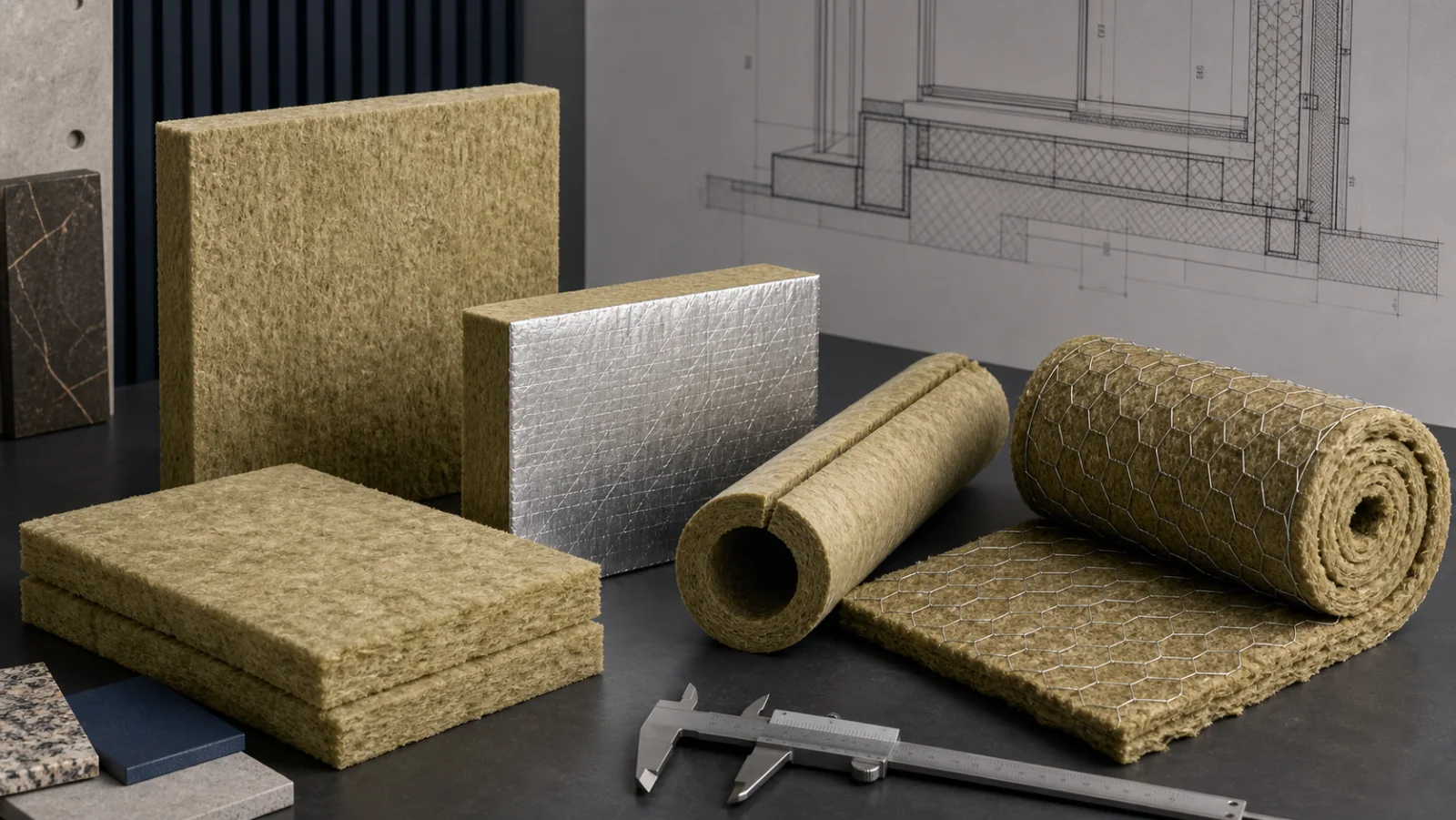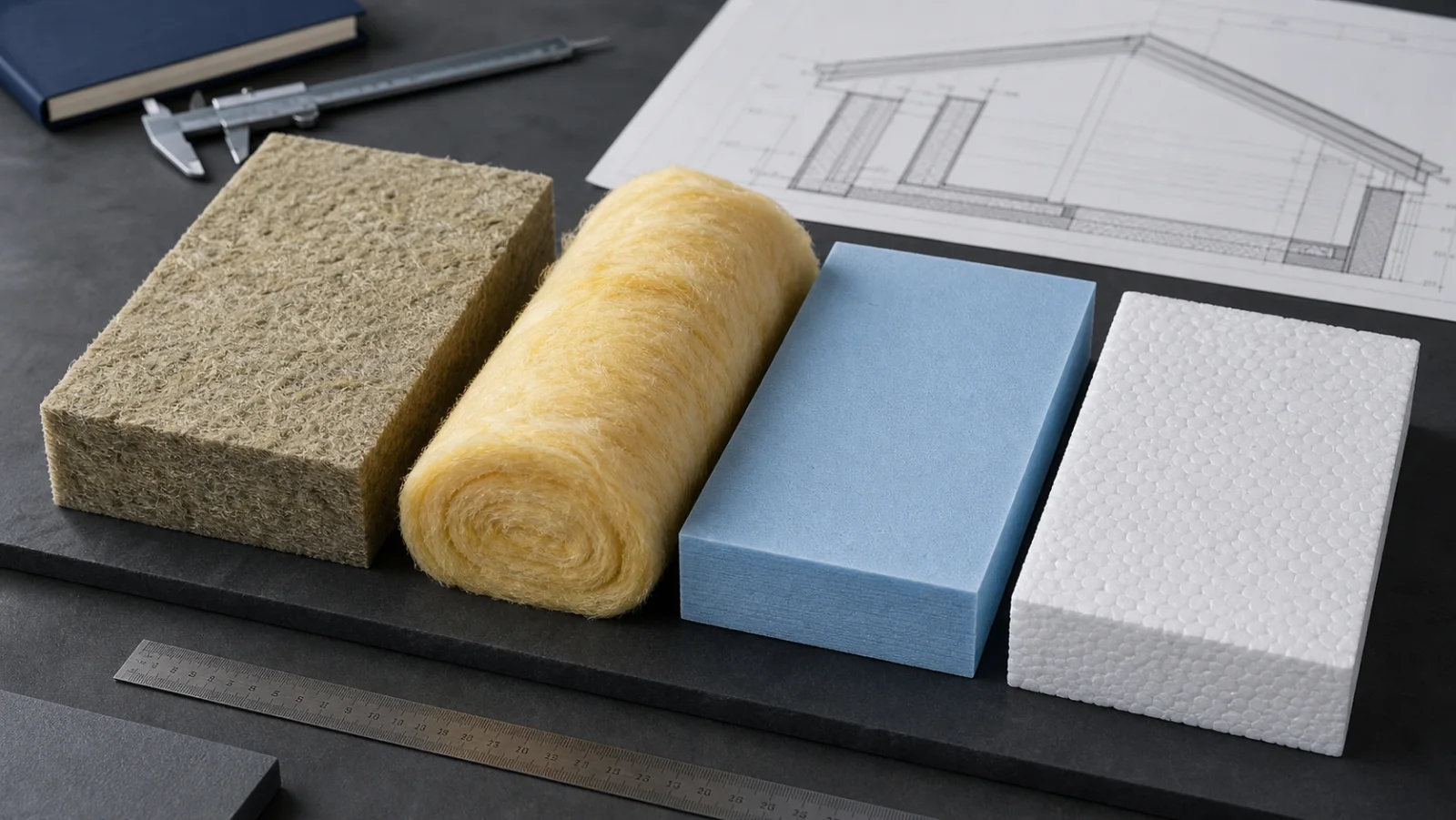
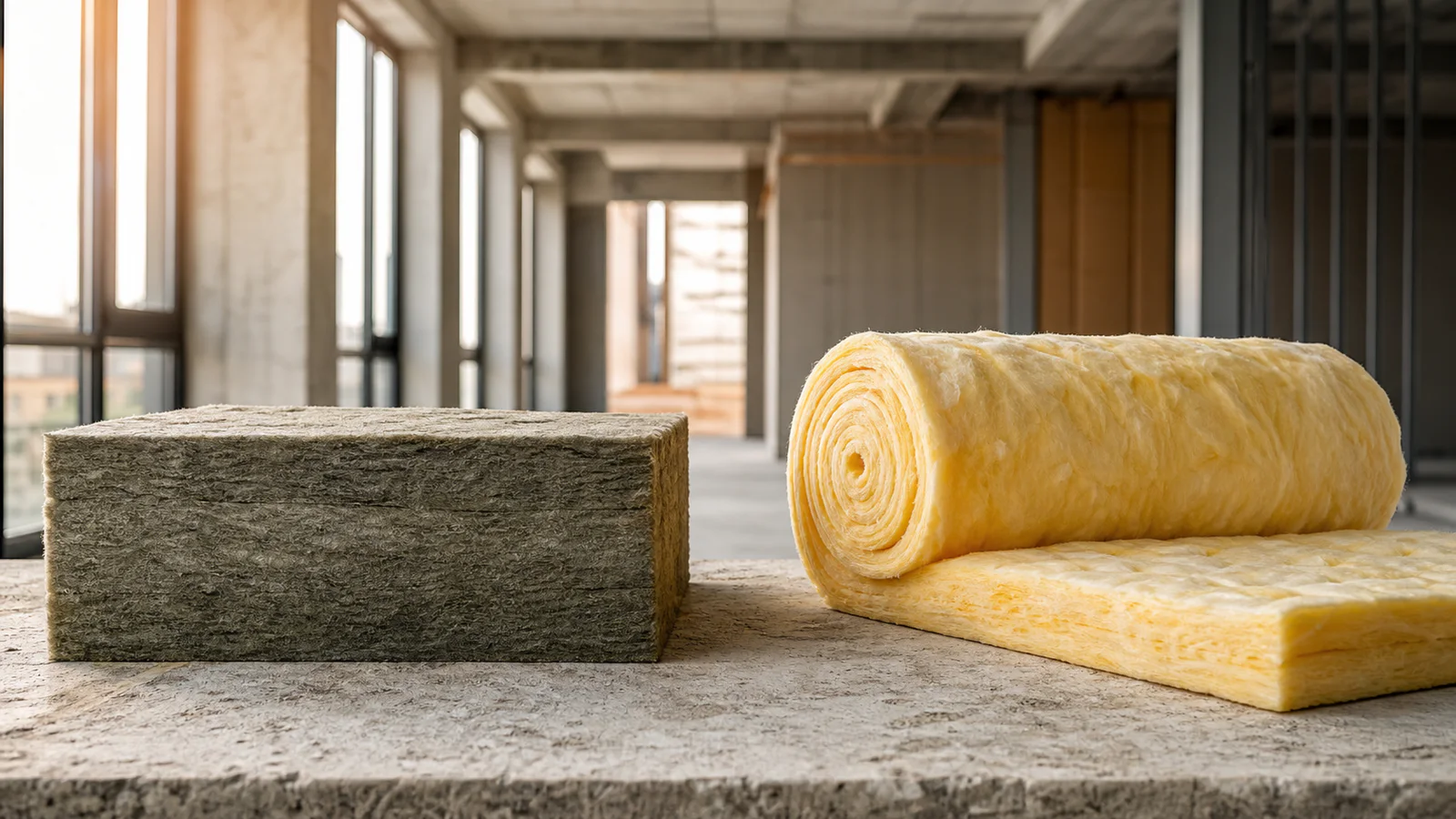
Stone wool or glass wool? There is no single winner. Both belong to the mineral wool family and contribute to thermal, acoustic and fire performance within the right system. Stone wool stands out in details requiring rigid boards, mechanical strength and high temperatures, while glass wool offers advantages in lofts and lightweight partitions through its low weight, flexible blanket form and ease of installation over large areas.
Do not decide by material name alone. Assess declared thermal conductivity, thickness, reaction-to-fire class, facing, mechanical properties and suitability for the building element together.
Main Differences Between Stone Wool and Glass Wool
| Criterion | Stone wool | Glass wool |
|---|---|---|
| Common form | Board, blanket, preformed pipe section and loose fibre | Blanket, board, preformed pipe section and composite panel |
| Structural character | Usually more rigid and available in different densities | Lightweight, flexible, compression-packed options are common |
| Key applications | External insulation, curtain walls, flat roofs, technical and industrial insulation | Unused lofts, between rafters, partitions and services |
| Thermal performance | Depends on product lambda value and thickness | Depends on product lambda value and thickness |
| Sound control | Effective as fibrous fill in wall, ceiling and façade cavities | Effective as fibrous fill in lightweight partitions and roof voids |
| Fire | Many unfaced products offer A1-class options | Many unfaced products offer class A options; check product documentation |
| Critical selection data | Mechanical classes such as compression, tension and point load | Blanket/board form, facing direction and installation without compression |
Which Provides Better Thermal Insulation?
The names “stone wool” and “glass wool” alone do not determine insulation performance. The key relationship is between declared thermal conductivity and installed thickness. Approximate thermal resistance is assessed using R = thickness / lambda. At equal thickness, a lower-lambda product can provide higher thermal resistance, but the U-value of the whole wall or roof must include the other layers.
Compare the labelled lambda class, thickness and gap-free installation. Compressing a blanket, leaving gaps between boards or retaining thermal bridges prevents catalogue performance from being achieved on site. See the stone wool dimensions and thickness guide for thickness and quantity selection.
Stone Wool or Glass Wool for Sound Insulation?
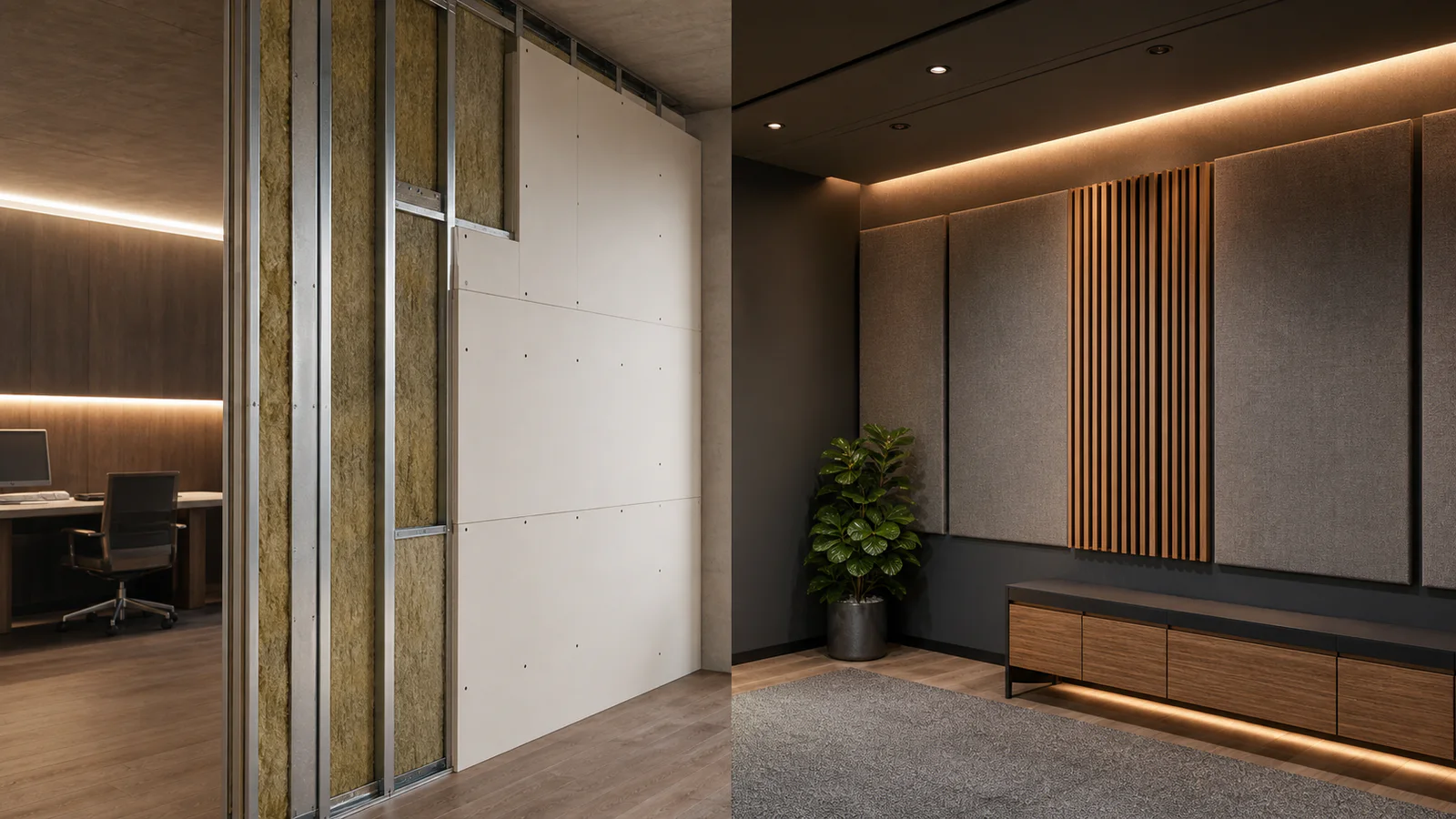
The fibrous, open-pore structure of both materials helps damp sound energy in wall and ceiling cavities. However, putting mineral wool in a cavity alone does not provide complete sound insulation. Good results depend on lining mass and layer count, decoupled framing, perimeter sealing and mineral wool correctly filling the cavity.
The higher density of stone wool does not automatically mean better sound insulation at every frequency. Read a partition's laboratory value as a result for the entire tested system. Choose a product such as Partition Board at a thickness matching the stud cavity, without crushing the material or leaving gaps.
What Should Be Checked for Fire Performance?
Mineral wools are strong product families for fire safety. İzocam states that under TS EN 13501-1, its unfaced stone wool products include A1-class options. Glass wool also offers class A products. However, aluminium foil, glass tissue, kraft paper or another facing can change the final product's reaction-to-fire class.
The insulation fill's class alone is not enough for a building. The entire wall, façade, roof or services system must meet the specified fire requirement, including linings, connections, firestops and junctions. Do not decide from product colour or a generic material name without reviewing the current declaration of performance and data sheet.
Quick Selection by Application
| Application | Commonly preferred option | Why? |
|---|---|---|
| Unused loft | Glass wool roof blanket | Lightweight rolls are easy to lay over large unloaded surfaces |
| Rendered external wall insulation | Stone wool board manufactured for façades | Dedicated products offer tensile strength and rigidity suitable for rendered systems |
| Plasterboard partition | Stone wool or glass wool board suited to the system cavity | Selection primarily follows the tested wall system and stud depth |
| Curtain wall | Façade-specific stone wool or mineral wool board | Requires a product suited to wind, cladding and fire details |
| Hot pipes and industrial facilities | Stone wool pipe section/blanket of the appropriate temperature class | Technical products are available for high operating temperatures |
| Lightweight pitched roof and between rafters | Glass wool blanket or board suitable for the design | Flexible material helps fill between rafters without gaps |
Density Alone Is Not a Selection Criterion
Density is frequently asked about for stone wool, but it is not itself a thermal, acoustic or mechanical performance class. Products of equal density can have different fibre orientations, binders, facings and manufacturing structures. Tensile strength perpendicular to the surface is more meaningful for ETICS, compressive strength for flat roofs and the system's airborne sound insulation value for acoustic partitions.
Likewise, glass wool should not be judged only by roll weight. Verify product type, nominal thickness, lambda value, facing and intended use from the data sheet.
Request These Five Items When Selecting
- Full product name and intended use
- Declared thermal conductivity and selected thickness
- Reaction-to-fire class and facing information
- Compressive, tensile or acoustic system performance appropriate to the application
- Current declaration of performance, CE/TSE information and installation detail
Frequently Asked Questions
Does stone wool insulate heat better than glass wool?
Not always. Compare thermal performance using declared lambda values and thicknesses. The material name alone is insufficient.
Can stone wool be used in a loft?
Stone wool products suitable for the roof system can be used, but light glass wool blankets are easier to install in many unused, unloaded lofts. Roof type and condensation details govern selection.
Is high-density stone wool essential for sound insulation?
No. Sound insulation is the performance of the entire wall, ceiling or floor system. Correct cavity filling, lining mass, decoupling and sealing must be assessed together.
Which way should the foil face on mineral wool?
The foil's role and orientation depend on the system's vapour calculation. For some products, such as roof blankets, the manufacturer requires the foil face on the warm side. Do not make the same assumption for every product.
Can stone wool and glass wool be used together?
Different mineral wools can be selected for different building elements in one project. If combined in the same assembly, verify vapour, fire, mechanical and connection details throughout the design.
Conclusion: Stone wool is common in rigid façade, roof and technical applications, while glass wool is common in lightweight roofs and partitions. The right choice depends on building needs and documented technical values rather than the product name. Compare stone wool products, glass wool products and İzocam stone wool solutions, and obtain technical support from Erk İzolasyon for a product suited to your assembly.