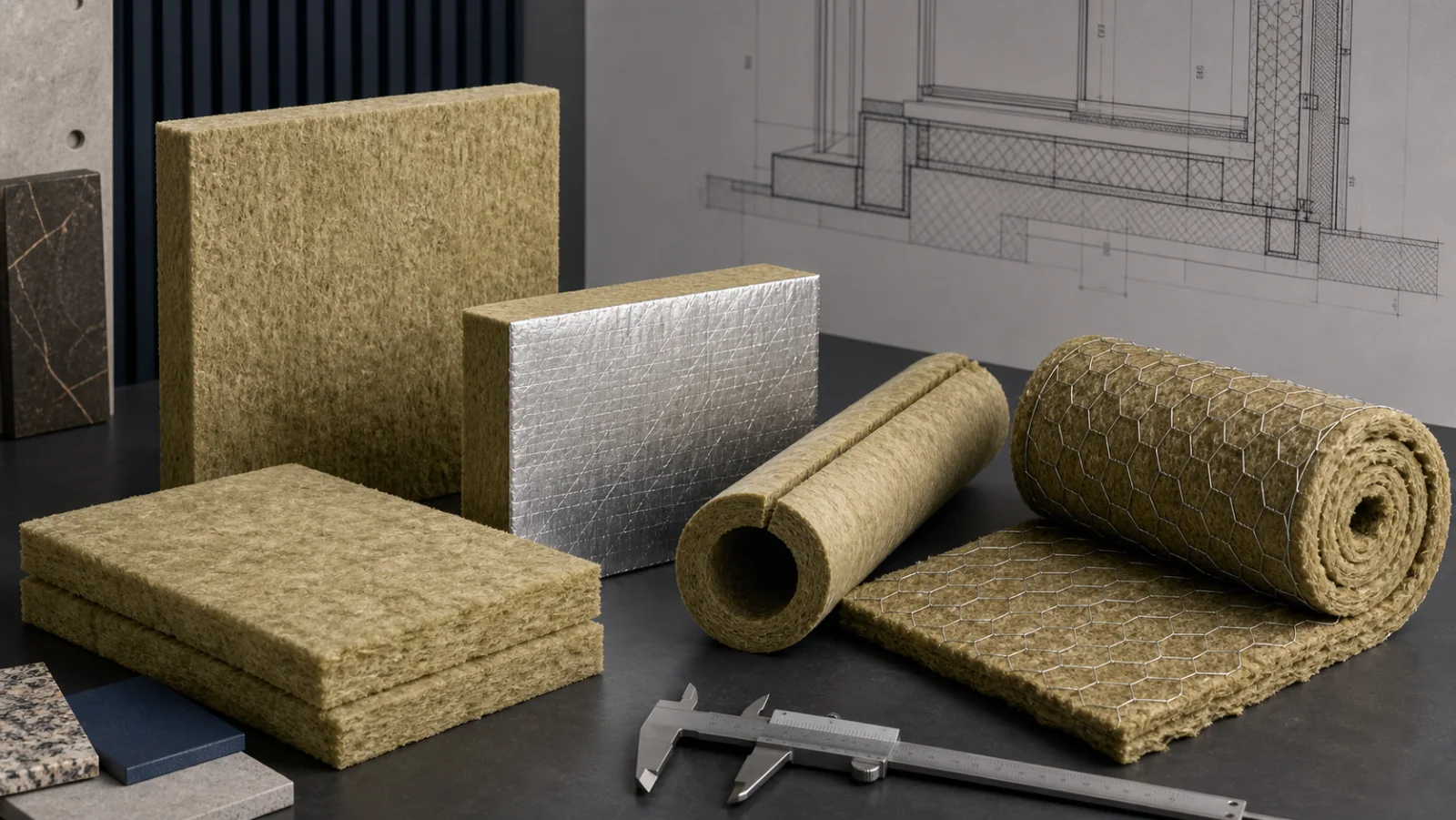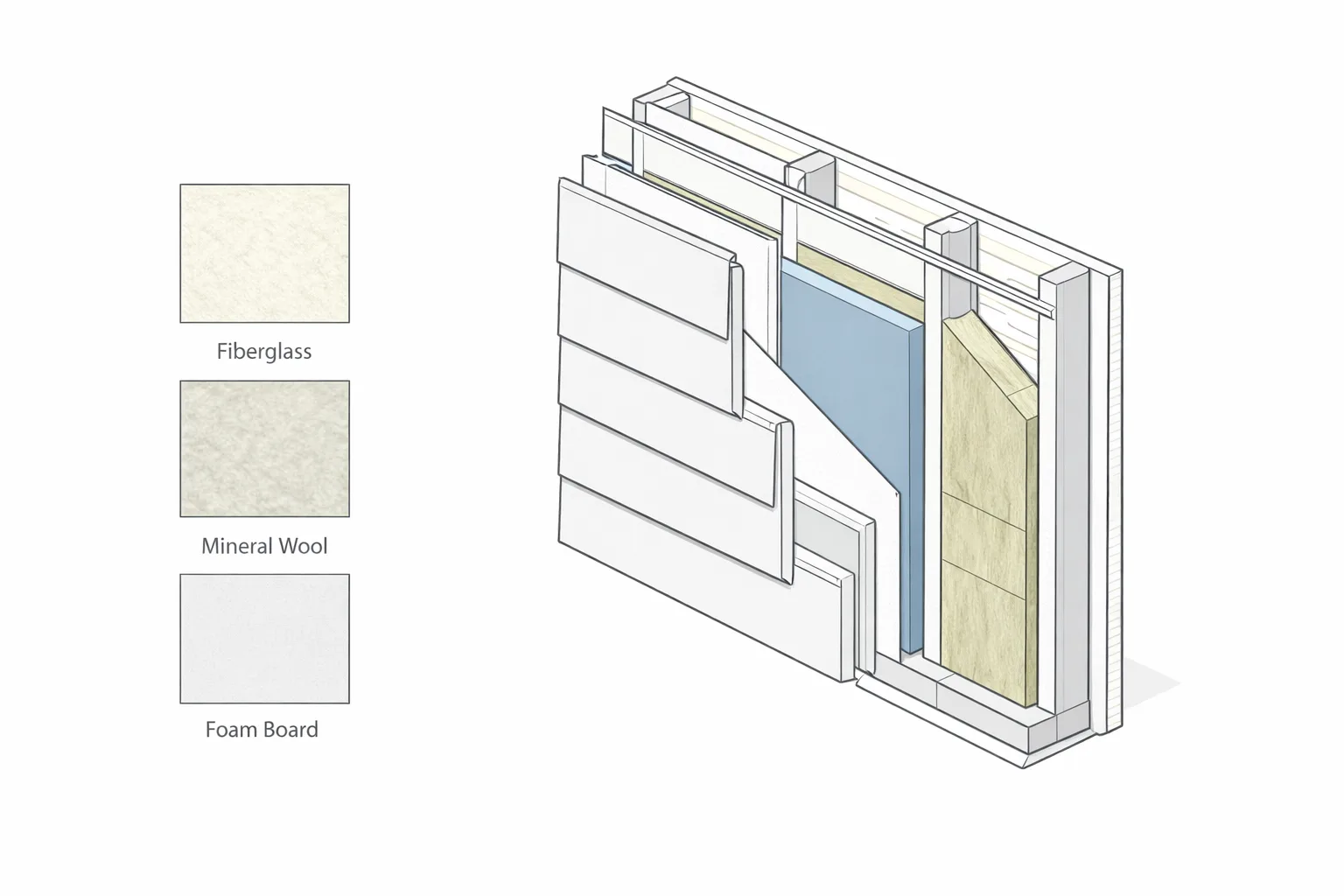
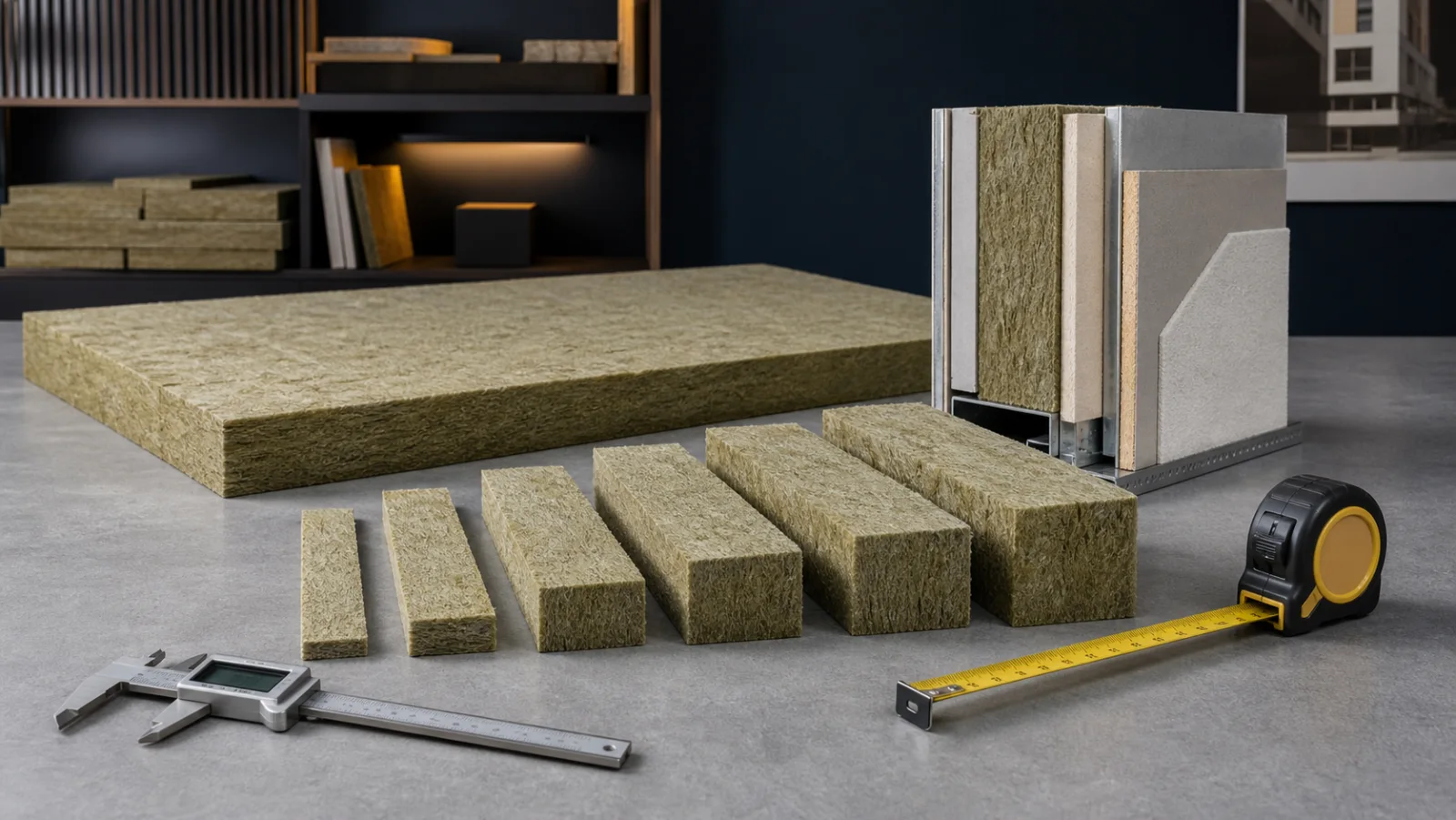
Stone wool dimensions and thicknesses must be assessed alongside the system where they will be used. Rigid external wall boards, partition cavity boards, foil-faced duct boards and preformed industrial pipe insulation may use the same material but have different dimensions and mechanical properties.
Answers to “is 5 cm stone wool enough?” or “how many m² does 10 cm stone wool cover?” depend on more than thickness. You must also know the declared thermal conductivity, building element, climate zone, target U-value, board dimensions and boards per pack.
Dimensions, Thickness and Density Are Different
- Width and length: The board's surface dimensions, related to quantity and support framing spacing.
- Thickness: Material depth in the heat-flow direction, directly affecting thermal resistance.
- Density: Material mass per unit volume, expressed in kg/m³. It is not a quality or thermal insulation measure on its own.
- Lambda value: Declared thermal conductivity in W/mK; a lower value means higher thermal resistance at equal thickness.
- R-value: The insulation layer's thermal resistance, approximated by dividing thickness in metres by lambda.
“High-density stone wool” alone is insufficient when buying. Different properties matter: perpendicular tensile and compressive strength for rendered façades, continuous cavity filling for partitions, load-bearing capacity for roofs and operating temperature and facing for services.
What Is the Standard Stone Wool Board Size?
İzocam's current technical product pages use 600 × 1200 mm, or 60 × 120 cm, for many building-grade stone wool boards. The net area covered by one board in this format is:
0.60 m × 1.20 m = 0.72 m²
This size is not universal. Preformed pipe sections are selected by nominal diameter and wall thickness, industrial blankets by equipment surfaces, and special façade or roof products by their system dimensions. Specify width, length and thickness separately alongside the product name when ordering.
How Do İzocam Stone Wool Thicknesses Vary by Product?
| Product and application | Example dimensions on the current technical page | Key selection criterion |
|---|---|---|
| Manto Stone Wool — rendered façade | 60 × 120 cm; 3, 4, 5, 6, 8, 10 and 12 cm | TS 825 calculation, lambda, tensile/compressive strength and ETICS compatibility |
| Partition Board — lightweight partition | 60 × 120 cm; options from 3–12 cm depending on product type | Stud depth, gap-free fitting and acoustic system design |
| External Wall Board — behind curtain walls | 60 × 120 cm; 3, 4, 5, 6, 8, 10 and 12 cm | Façade cavity, cladding type, mechanical fixing and wind effects |
| Stone Wool HVAC Board — HVAC ducts | 60 × 120 cm; 2.5, 3, 4 and 5 cm | Duct temperature, condensation calculation, foil and tape continuity |
| Preformed Stone Wool Pipe Section — industrial lines | Inside diameter matching nominal pipe size and wall thickness matching the design | Line temperature, pipe diameter, surface temperature and external protection |
| Industrial Stone Wool Blanket — tanks and equipment | Blanket form and thickness according to project/equipment conditions | Operating temperature, curved surface, wire support and metal cladding |
These figures explain product families; exact stocked options and pack quantities can vary over time. Check the selected product's current data sheet and packaging before requesting a quotation. See products grouped by use on the İzocam stone wool solutions page.
What Is the Thermal Difference Between 5 cm and 10 cm Stone Wool?
For the same product and lambda value, the insulation layer's R-value increases with thickness. The basic relationship is:
R = d / λ
Here, d is thickness in metres and λ is declared thermal conductivity in W/mK. For example, the product page for İzocam Manto Stone Wool with lambda 0.039 W/mK declares that its 5 cm board has an R-value of 1.25 m²K/W and its 10 cm board has an R-value of 2.55 m²K/W.
| Same product | Thickness | Declared R-value |
|---|---|---|
| İzocam Manto Stone Wool, λD 0.039 W/mK | 5 cm | 1.25 m²K/W |
| İzocam Manto Stone Wool, λD 0.039 W/mK | 10 cm | 2.55 m²K/W |
This compares only the insulation board layer. The wall's total U-value includes the existing wall, render, reinforced concrete elements, thermal bridges and surface resistances. Although a 10 cm board offers roughly twice the board resistance of 5 cm, it cannot be said to “halve” the building's total energy consumption alone.
How Many Centimetres of Stone Wool Are Needed?
Do not select thickness randomly from a catalogue; calculate it to meet the building element's target thermal transmittance. From 1 April 2025, TS 825:2024 took effect in Türkiye, increasing climate zones to six and including cooling demand more comprehensively alongside heating.
The same thickness therefore cannot be recommended for an Istanbul external wall, an Erzurum roof, a sun-exposed Antalya façade and a heated industrial space. A correct calculation requires:
- The building's province, district and current climate zone
- The application: wall, roof, floor or services
- Existing layer materials and thicknesses
- The selected stone wool's current lambda value
- Target U-value and energy performance
- Condensation risk, vapour control and thermal bridges
- Total detail depth available for the system
For new buildings and permit-related work, determine thickness from the TS 825 thermal insulation calculation and designer's details. For existing buildings too, assessment based on wall construction and target performance is safer than choosing the most common market thickness.
Thickness Selection by Application
External wall insulation
Besides thickness, a rendered façade board must be manufactured for the external insulation system. Manto Stone Wool is an ETICS product working with adhesive, fixings, render and mesh. Even at the same thickness, Partition Board must not be used beneath ETICS render.
Partitions and wall linings
Match stone wool thickness to the framing cavity; do not compress the board thinner or leave gaps at edges. Thicker fill can support sound control, but acoustic performance depends on more than stone wool. Plasterboard layers, framing arrangement, connection tapes, airtightness and perimeter joints work together.
Curtain walls
Determine External Wall Board thickness together with the wall thermal calculation and façade support depth. Boards must not block the ventilation cavity or move under wind, and mechanical fixings must avoid thermal bridging.
HVAC ducts and industrial pipes
Do not use building-wall thickness guidance for services. Calculate duct or pipe operating temperature, outdoor conditions, condensation risk, target surface temperature and allowable energy loss separately. A pipe section's inside diameter must match the pipe outside diameter, and its wall thickness the technical calculation.
How Is Stone Wool Pack Coverage Calculated?
First calculate one board's area:
Board area = width × length
A 60 × 120 cm board gives 0.72 m². If a pack contains 8 boards, its coverage is:
8 × 0.72 m² = 5.76 m²/pack
Boards per pack generally decrease as thickness increases. There is no fixed answer to “how many m² in one pack of stone wool?”; 5 cm and 10 cm packs may cover different areas.
Example quantity calculation
For a net insulation area of 25 m² and 60 × 120 cm boards, the theoretical board count is:
25 / 0.72 = 34.72
Round upwards to at least 35 boards. Add waste appropriate to the geometry for window returns, corners, cuts and breakage. Finally divide the required board count by the current boards per pack, again rounding packs upwards.
Does Higher Density Always Improve Thermal Insulation?
No. Stone wool density relates to fibre arrangement, mechanical strength and use, but does not alone indicate thermal quality. Products of the same density may have different lambda values or mechanical classes; different-density products may have similar conductivity.
For correct comparison, read application-relevant declarations together: lambda, reaction-to-fire class, thickness tolerance, water absorption, compressive strength and perpendicular tensile strength. Product standard and intended use are more decisive than kg/m³ alone.
Common Quantity and Thickness Selection Mistakes
- Assuming 5 cm or 10 cm is enough for every building without climate and wall calculations
- Using all equal-thickness stone wool boards interchangeably
- Comparing density alone instead of lambda
- Assuming pack coverage is fixed and independent of thickness
- Generalising 60 × 120 cm to all pipe, blanket, roof and special façade products
- Omitting door, window, corner and cutting allowances
- Over-compressing partition boards to fit the studs
- Using non-system boards under external insulation render
Frequently Asked Questions
What is the standard stone wool board size?
Many İzocam building-grade stone wool boards measure 60 × 120 cm, covering 0.72 m² each. Pipe, blanket and special application products use different dimensions; check the exact product data sheet.
Is 5 cm stone wool sufficient?
Thickness alone cannot establish adequacy. Assess climate zone, building element, existing wall layers, lambda value and target U-value together in the TS 825 calculation.
Does 10 cm stone wool insulate twice as well as 5 cm?
For the same product, 10 cm has approximately twice the R-value of 5 cm. Total building heat loss also depends on other wall layers, windows, roof, floor and thermal bridges, so energy savings cannot be read directly as double.
How many m² does a pack of stone wool cover?
Multiply board width and length by boards per pack. Pack count can change with thickness and product type; check the pack label or current price/product list.
What density should stone wool have?
No single density suits all applications. External insulation, partitions, curtain walls, roofs and industry require different mechanical properties. Select a suitable product and technical declarations together rather than density alone.
Conclusion: Select stone wool thickness from the application, lambda value and design calculation rather than the nearest stocked size. Calculate board area and pack quantity separately, adding waste for project geometry. Compare stone wool products and obtain technical support from Erk İzolasyon for the right product, thickness and pack quantity.