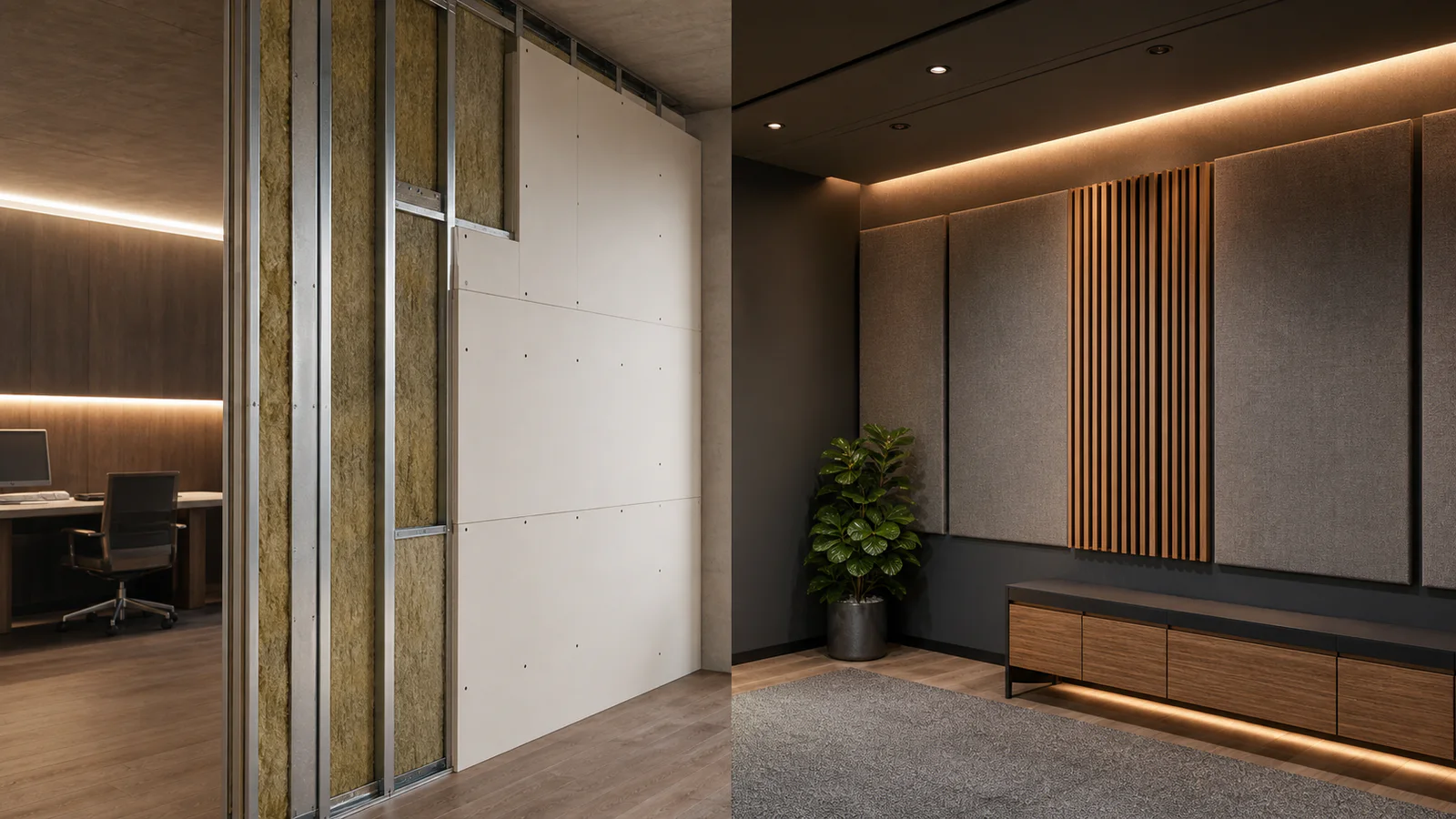
Sound insulation aims to reduce sound passing between rooms or from outside to inside. Acoustic treatment controls echoes, reverberation and speech intelligibility within the same room. Applying pyramid foam to a wall can reduce reflections in the room, but does not by itself stop a neighbour's speech or television noise.
İZODER likewise defines sound insulation as reducing sound transmitted through building elements, and acoustic treatment as controlling the reverberation time of an existing enclosed space. To choose the right product, first establish whether the problem is “sound transmission” or “room echo”.
Comparing Sound Insulation and Acoustic Treatment
| Criterion | Sound insulation | Acoustic treatment |
|---|---|---|
| Purpose | Reduce sound transmission between spaces | Control reflections and reverberation within a room |
| Typical complaint | Neighbours' speech, traffic, impacts from upstairs, services noise | Echoes, unclear speech, harsh and tiring room sound |
| Basic approach | Mass, decoupling, fibrous cavity fill and sealing | Sound-absorbing surface area and correct placement |
| Common products | Multiple board layers, mineral wool, acoustic barriers, resilient tapes and hangers | Fabric-covered panels, timber absorbers, ceiling clouds, acoustic foam |
| Measurement | Sound reduction performance of the building element and site measurement | Reverberation time, speech intelligibility and frequency response |
Identify the Type of Noise First
Sound does not always travel the same way. The solution varies with the source and transmission path:
- Airborne sound: Sound travelling through air, such as speech, television, music and traffic. It can pass through walls, windows, doors and openings.
- Impact sound: Vibration imparted to the structure by walking upstairs, dragging furniture or objects falling on the floor.
- Structure-borne sound: Vibration transferred to the structure through connections by machinery, pumps, lifts and services.
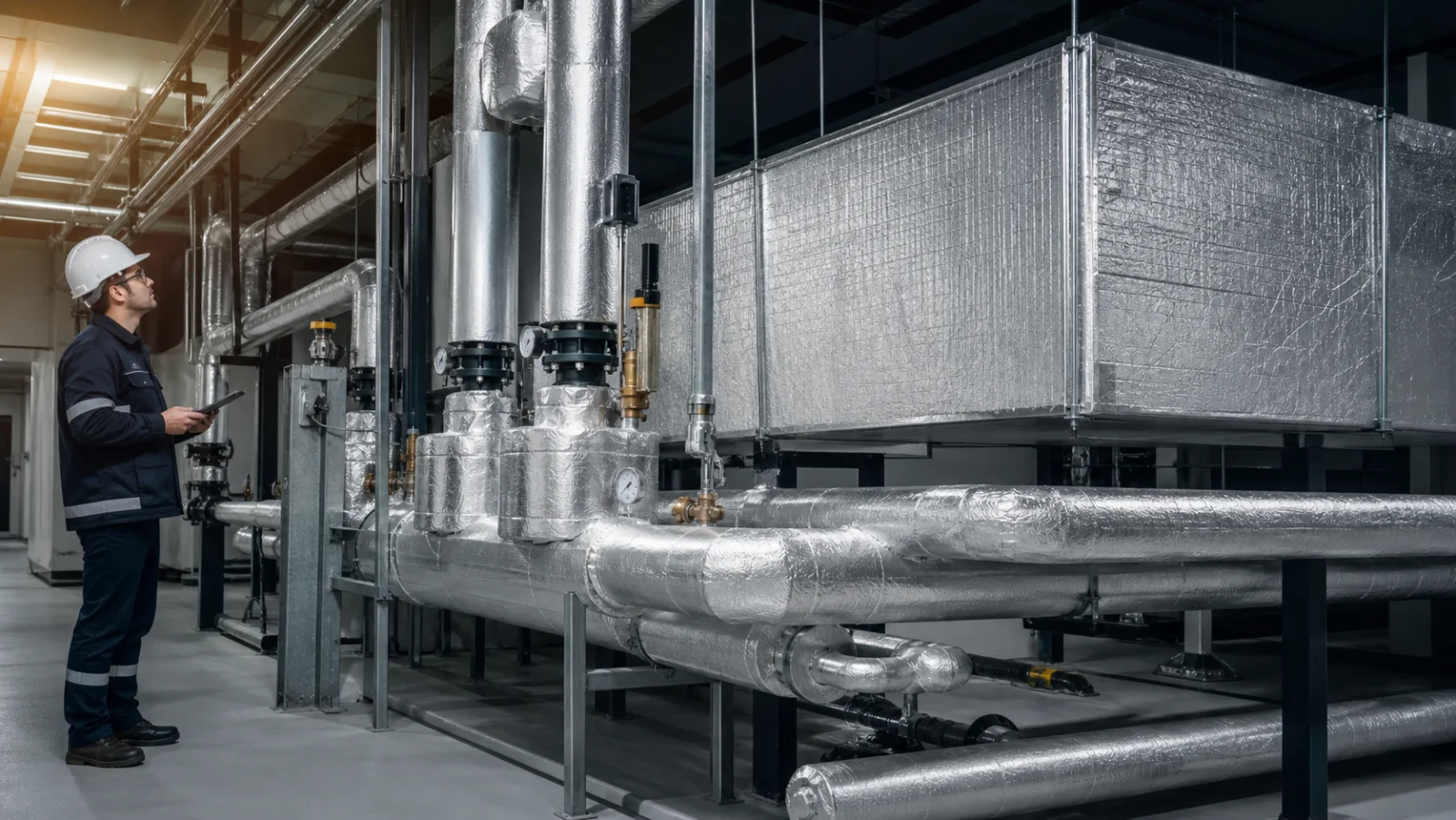
- Services noise: It can be transmitted through clamps, shafts and wall penetrations as well as by flow inside pipes.
For example, a suspended ceiling alone is not always enough to address upstairs footsteps; a floating floor and perimeter isolation on the upper floor where the impact originates may be the most effective solution. For traffic noise, the weak point is often the window, frame joint or ventilation opening before the wall itself.
Four Basic Principles of Sound Insulation
1. Mass
Heavy, sealed layers help reduce airborne sound transmission. In lightweight partitions, multiple lining layers with suitable spacing and different surface densities can give a more balanced result than a single thick board. Adding weight alone, however, does not resolve structure-borne vibration.
2. Decoupling
Connecting two surfaces to the same rigid frame can create a sound bridge. Double frames, staggered studs, acoustic hangers and resilient connections reduce vibration transmission between surfaces. Rubber sound insulation tape beneath profiles helps limit vibration bridges at connections.
3. Fibrous cavity fill
Stone wool or glass wool helps damp resonance inside the framing cavity. The material should fill the space at the appropriate thickness, without compression or gaps. Mineral wool applied alone to an open wall does not stop sound transmission; it is part of an enclosed mass–cavity–mass system.
4. Sealing
Sound can escape easily through small openings. Socket boxes, door bottoms, wall perimeters, service penetrations and shared voids above suspended ceilings reduce system performance. Perimeter joints must be sealed continuously with suitable elastic acoustic sealant; opposing sockets should not be placed back-to-back in the same cavity.
How Does Acoustic Treatment Work?
Hard concrete, glass, ceramic and plaster surfaces can cause sound to reflect within a room for a long time. Acoustic panels absorb sound energy at particular frequencies, reducing reverberation time. This can improve speech intelligibility in classrooms and meeting rooms and general comfort in restaurants.
Panel quantity should not be chosen arbitrarily from floor area alone. Volume, use, surfaces, occupancy, target reverberation time and frequency distribution are considered. Thin acoustic foams are mostly effective at mid to high frequencies; low-frequency control may require thicker treatments, air gaps or specialised resonant solutions.
Which Product Performs Which Role?
| Product/layer | Main role | Is it enough on its own? |
|---|---|---|
| Stone wool or glass wool board | Damp sound energy in enclosed wall/ceiling cavities | No, a lining and decoupling system is needed |
| Multiple plasterboard layers | Increase surface mass and sealing | Does not address every transmission path alone |
| Bondex with Barrier | Combine a fibrous layer and a heavy barrier in a composite solution | Additional layers are needed according to the wall/ceiling detail |
| Resilient tape and acoustic hangers | Reduce rigid connections and vibration bridges | Works with the correct support and lining system |
| Fabric-covered acoustic panel | Reduce reflections within a room | For acoustic treatment rather than sound transmission |
| Pyramid foam | Provide room sound absorption at particular frequencies | It is not a wall system that blocks neighbours' noise |
Approaches for Walls, Ceilings and Floors
Party wall
After examining weaknesses in the existing wall and flanking transmission paths, a frame decoupled from the wall, mineral wool cavity fill, multiple board layers and perimeter sealing can be installed. The new lining is detailed to avoid rigid sound bridges to adjoining walls, ceiling and floor.
Ceiling
A ceiling system with acoustic hangers may help with airborne noise from upstairs. For impact sound, a floating floor on the source side is more effective. Services and shared shafts within the ceiling void must be checked separately.
Floor
To address impact sound, screed or a dry floor is floated on a resilient layer and isolated from walls using perimeter strip. A sound bridge can form if skirting, door thresholds or service pipes rigidly connect the floating layer to the structure.
Diagnostic Checks Before Installation
- At what times does the sound occur, and which source is operating?
- Is it speech/music, impact or machinery vibration?
- Is the highest level at the wall, ceiling, floor, window or shaft?
- Are there open leakage paths at sockets, doors, pipe penetrations or above the suspended ceiling?
- Is the aim simply to reduce disturbance, or to achieve a regulatory/design value?
For demanding residential, studio, hotel, school or plant room projects, measurement and calculation by an acoustic specialist reduce the cost of trial and error.
Common Mistakes
- Marketing acoustic foam as a sound insulation board
- Only increasing mineral wool density while neglecting linings and sealing
- Fixing a new frame to the existing wall with numerous rigid connections
- Leaving openings at sockets, pipes and door bottoms
- Addressing impact noise only at the downstairs neighbour's ceiling
- Ignoring indirect transmission through adjoining walls and floors
Frequently Asked Questions
Does acoustic foam block neighbours' noise?
Not on its own. Foam can reduce reflections within a room. Neighbours' noise requires a building system incorporating mass, decoupling, fibrous fill and sealing.
Does stone wool provide sound insulation?
Stone wool helps damp sound energy in enclosed wall or ceiling cavities. Placing it on an open surface alone does not provide complete sound insulation.
How can footsteps from upstairs be reduced?
The most effective approach is usually a floating floor and perimeter isolation on the source side. An acoustic suspended ceiling below can help; the structure and flanking paths must be examined.
Is a thick wall or a double wall better?
The outcome depends more on system mass, decoupling between the two faces, cavity fill and sealing than on material thickness alone. Compare tested system values.
How is the number of acoustic panels calculated?
It is calculated from room volume, intended use, existing surfaces and target reverberation time. Covering a fixed percentage of wall area alone is not right for every room.
Conclusion: Sound insulation is needed to reduce sound coming from outdoors or neighbours; acoustic treatment is needed to correct room echoes. Buying products without correctly identifying the problem can result in a visible but ineffective installation. Browse sound insulation products, acoustic stone wool options and related accessories, and obtain technical support from Erk İzolasyon for system selection.