
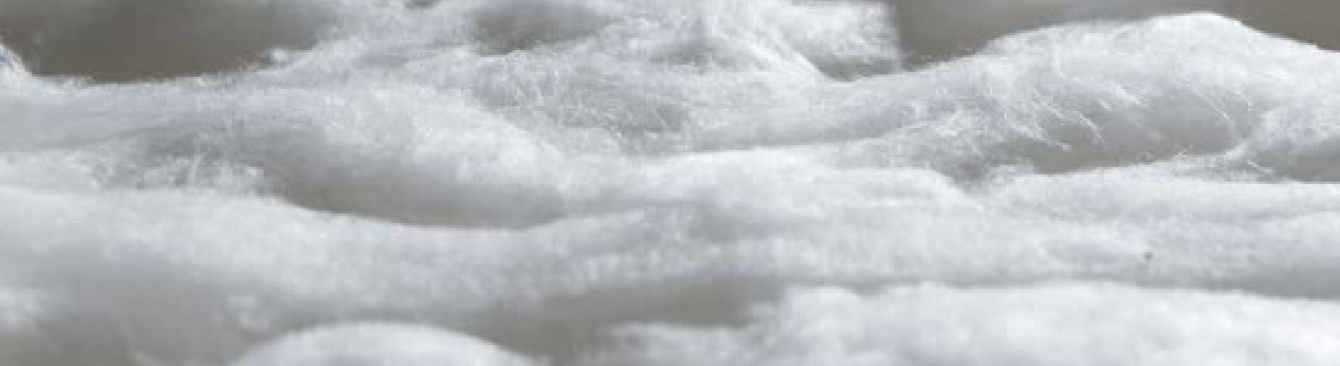
Ceramic wool is a fibrous material used to thermally insulate equipment operating at high temperatures. In furnaces, boilers and some process equipment, the product's temperature capability, compatibility with the chemical environment and installation method must be assessed together. The roll thickness or a single temperature value on the packaging does not provide enough information for selection.
Ravago offers Ravatherm ceramic wool in different forms, including blankets and loose fibre; defined uses include industrial furnaces and boiler and flue insulation. When reviewing the ceramic wool product in the ERK catalogue, clarify which form, density and temperature class the quotation covers.
Where Is Ceramic Wool Used?
The blanket form is considered where a flexible high-temperature insulation layer is needed. Loose fibre can perform different roles, such as filling or manufacturing shaped products. Morgan Thermal Ceramics' product and systems catalogue shows that blankets, boards and modules have distinct application methods.
The lining facing the hot side of a furnace and the backup insulation behind it do not face the same conditions. Tell the equipment manufacturer about flame contact, gas flow, vibration or chemical exposure. Do not assume a heat-resistant fibre can be left exposed everywhere or directly replace the existing refractory lining.
Temperature Class and Continuous-Use Limit
Classification temperature describes a product's behaviour under defined test conditions. Continuous-use temperature is the limit declared by the manufacturer for prolonged operation. These two values can differ. Morgan's explanation of temperature classification addresses this distinction through dimensional shrinkage and the behaviour of the fibre structure.
For a specific example, the Cerablanket data sheet dated 1 January 2025 gives a classification temperature of 1260°C and a continuous-use temperature of 1180°C. These values belong to that Morgan product; they cannot be used as limits for Ravatherm or another ceramic wool. The example shows why both figures should be requested separately when purchasing.
Record short-term peak temperatures and their duration as well as the equipment's normal operating temperature. Do not treat a catalogue classification temperature as the plant's continuous operating target without manufacturer approval.
How Should Density and Thickness Be Compared?
Density is expressed in kg/m³ and thickness in mm. Two blankets of the same thickness can have different densities. When comparing thermal conductivity, check that the measurement temperatures also match; do not assess a high-temperature material using only a room-temperature value.
| Information to request in the quotation | What it means for the decision |
|---|---|
| Continuous-use temperature and environmental conditions | Suitability for the process operating regime |
| Thickness and number of layers | Definition of the calculated assembly and total material quantity |
| Density and thermal conductivity at the relevant temperature | Comparison of quotations on the same technical basis |
| Roll width, length and pack quantity | Calculation of net area, cutting plan and order quantity |
| Fixing and surface protection detail | Explanation of how the insulation will be retained on the equipment |
For example, two quotations stating only “50 mm ceramic wool” are not equivalent. Product code, density, temperature limit and roll area must also be assessed on matching terms. The total thickness needed to achieve the desired outer surface temperature is determined by technical calculation; a fixed thickness suitable for every furnace cannot be recommended here.
From Roll Area to Order Quantity
One size example on Ravago's product page is 25 × 610 × 7200 mm. With a thickness of 25 mm, width of 0.61 m and length of 7.20 m, the gross surface area of one roll is 0.61 × 7.20 = 4.392 m². Thickness is not part of this area multiplication. Confirm the pack dimensions of the product to be supplied separately.
Purely to illustrate quantities, a single layer over 20 m² of flat surface without cutting loss gives 20 ÷ 4.392, or approximately 4.55 rolls; this rounds up to 5 rolls when ordering whole rolls. This example is not a thickness recommendation and does not include the actual cutting plan. Multiple layers, equipment geometry and junction details change the order quantity.
Should Ceramic Wool Be Chosen Instead of Stone Wool?
Materials should not be substituted simply because one “withstands a higher temperature”. Building façades, partition walls and industrial furnaces have different product and system requirements. The intended use, temperature limit and installation method specified in the project govern selection. Review the guide to stone wool applications and the industrial technical insulation article to distinguish these needs.
Safety During Cutting and Maintenance
For ceramic fibre products, check the fibre type and safety information. The UK's Health and Safety Executive, HSE, advises avoiding inhalation of refractory ceramic fibre dust and skin contact in its kiln insulation guidance. This source should not be used as a regulation or exposure limit for Türkiye.
Request the current Safety Data Sheet for the relevant product before cutting, installation and especially removal of old linings. The occupational safety specialist must determine dust control and personal protective equipment. This article is not an instruction manual for furnace repair or dismantling.
Frequently Asked Questions
Can ceramic wool classified at 1260°C operate continuously at 1260°C?
This cannot be concluded from the class alone. The manufacturer's continuous-use limit for the same product code and confirmation of suitability for the process environment are required.
Should I choose 25 mm or 50 mm ceramic wool?
The decision depends on the hot surface, target outer surface temperature, existing lining and operating regime. Thickness is determined by technical calculation; roll size or a low unit price alone is not a selection criterion.
Why do ceramic wool prices differ?
Product form, temperature class, density, thickness and pack quantity may differ. Align the technical specifications and quotation units before comparing prices; do not directly compare the price of one roll with a roll of another size.
Information for a Ceramic Wool Quotation
Send ERK İzolasyon the equipment type, normal and peak temperatures, application area and any product specification. Request quantity and supply information for ceramic wool options matching the technical requirements, or share your details via WhatsApp on 0554 713 71 72.
Sources were checked on 25 September 2026. Technical values from different manufacturers cannot be used interchangeably; final selection must follow the equipment design and current product documents.


