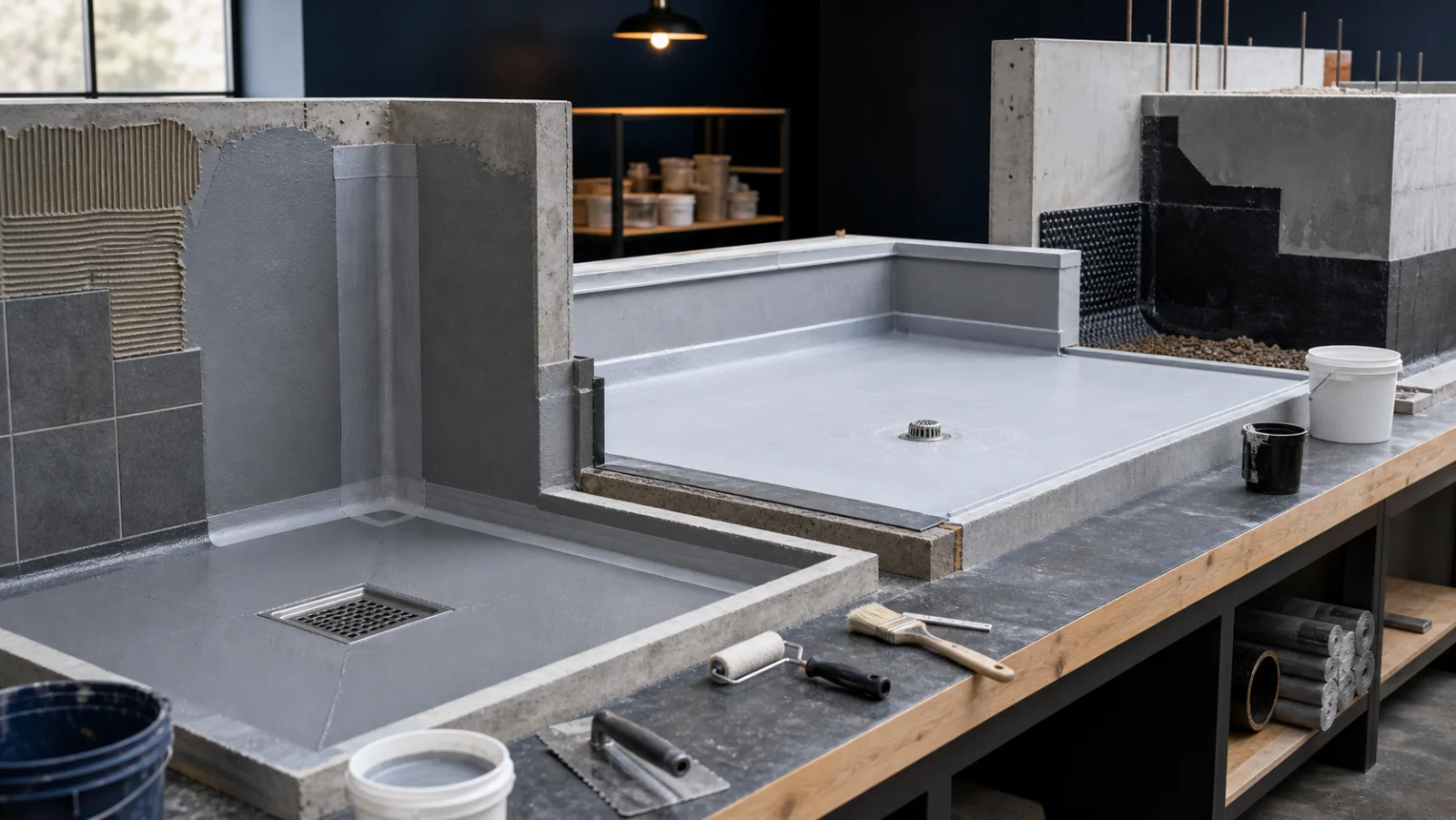
Waterproofing materials are selected by more than whether they come as liquid, powder or rolls. Selection changes with concrete, screed or existing finishes; positive- or negative-side water exposure; and sunlight, movement, foot traffic or ground pressure. A product right for a bathroom may therefore be wrong for an exposed terrace or foundation wall.
Sound selection first defines the application and loads, then the appropriate material family and product within it. Accessories such as primers, corner tapes, outlet collars, protection and finishes matter as much as the main waterproofing product.
What Types of Waterproofing Materials Are Available?
| Material family | Key application | Selection considerations |
|---|---|---|
| Cement-based liquid waterproofing | Bathrooms, balconies, pools, water tanks and mineral substrates | Flexibility class, water pressure direction and whether it will be covered |
| Elastomeric liquid membrane | Roofs, gutters, parapets, chimney bases and complex details | UV resistance, primer, dry film thickness and continuous water exposure |
| Polyurethane waterproofing | Exposed terraces, roofs, balconies, wet areas and some tank/pool systems | One or two components, UV resistance, topcoat and foot traffic conditions |
| Bitumen-based liquid waterproofing | Foundations, retaining walls, basements and ground-contact surfaces | Water loading, coat thickness, reinforcement mesh, protection and drainage |
| Bituminous or synthetic sheet membrane | Large foundation and roof surfaces | Overlaps, welding/bonding, corners, turn-ups and mechanical protection |
| Rapid water-plugging and repair mortar | Active local leaks, tie holes and substrate preparation | For local repairs before the main system, not a replacement for full-surface waterproofing |
No product family is inherently “best”. The best solution handles the expected water loading, bonds to the substrate and remains compatible with later layers. Review all groups in the waterproofing category.
Which Waterproofing Material Should Be Selected for a Bathroom?
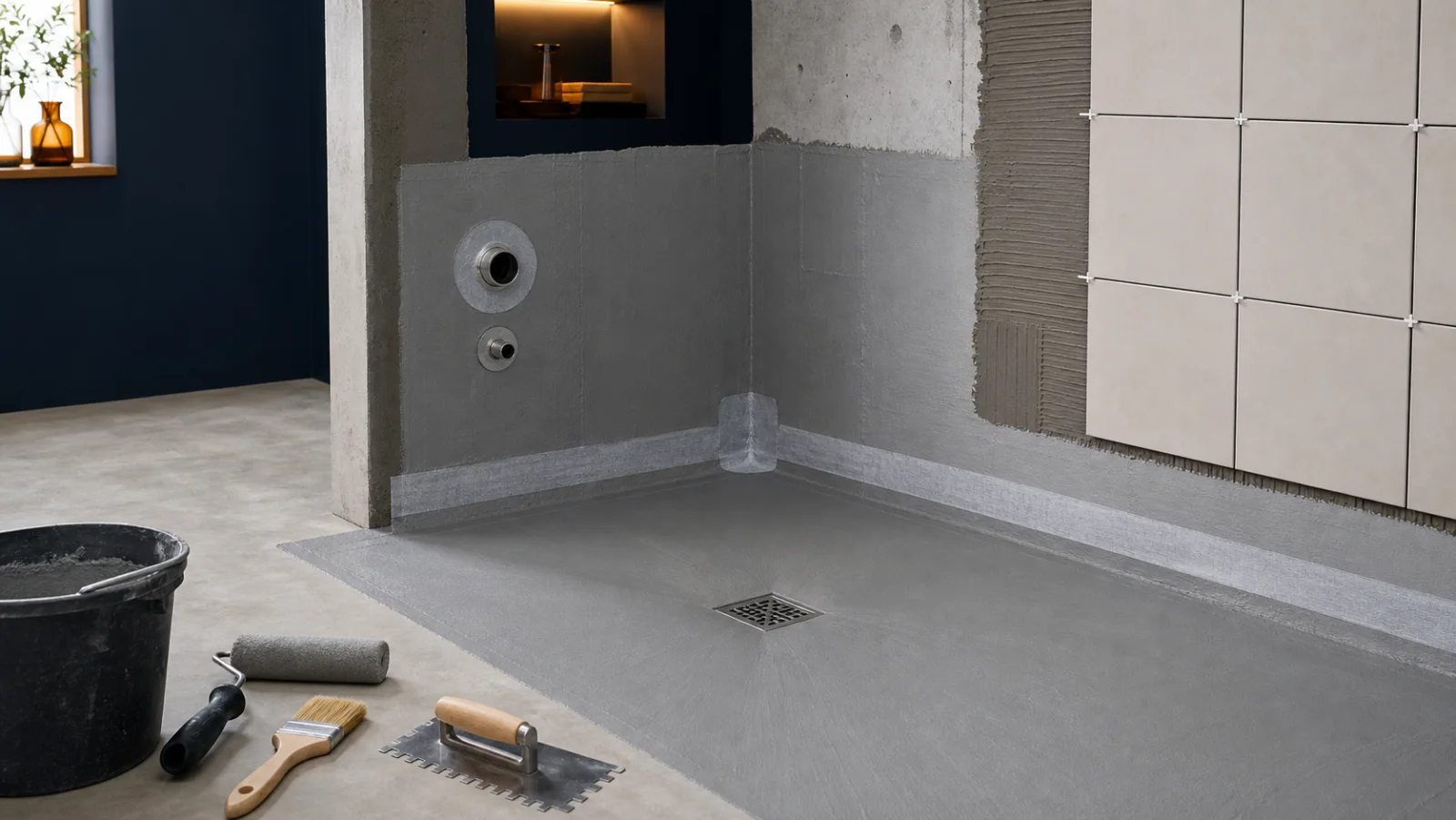
In bathrooms and showers, water generally arrives from above and waterproofing remains beneath tiles. Flexible cement-based waterproofing is common on mineral substrates such as concrete or cement screed. Ready-to-use liquid products suitable beneath finishes may also be considered according to design and substrate.
Tiles and grout do not form a waterproofing layer alone. Water can reach underlying layers through cracked grout, pipe penetrations, drain surrounds and wall-to-floor junctions. Prepare a continuous waterproof layer before tiling.
Critical bathroom details
- The substrate must be sound, clean, void-free and at the moisture condition required by the product.
- The floor must fall towards the drain; waterproofing must not be treated as a layer to compensate for low-point ponding.
- Reinforce wall-to-floor junctions, internal corners and dissimilar-material junctions with suitable waterproofing tape.
- Use collars at tap and pipe penetrations and a system-compatible flange around drains.
- Apply complementary coats while maintaining the data sheet's waiting periods and total thickness.
Weber Superflex D 24 is a flexible, two-component cement-based option for under-tile bathrooms, balconies and terraces. Make the final decision alongside existing substrate, finish type and detail components.
Which Waterproofing Material Should Be Selected for a Terrace?
A terrace faces harsher external conditions than a bathroom. Besides rain, temperature differences, sunlight, freeze-thaw, parapet and outlet details and structural movement stress the waterproofing. A tiled terrace and a roof with exposed waterproofing should not use the same system indiscriminately.
Tiled terrace
Flexible cement-based products technically specified beneath finishes can be considered with correct falls and detail tapes. Adhesive, tiles and grout above must also suit outdoor use and substrate movement. Avoid details that obstruct drainage beneath the finish.
Exposed terrace
For exposed surfaces, waterproofness alone is insufficient; the product must withstand UV and intended use. Weber Dry UV Coat is an elastic cement-based option for uncovered terraces and balconies requiring UV and light foot traffic resistance. Weber PUR Seal 2K forms a seamless polyurethane layer on terraces and wet areas with suitable system details.
When selecting polyurethane waterproofing, check the complete system for primer, main coat, UV-resistant topcoat and any non-slip/traffic-resistant finish. Not every polyurethane product is an exposed wearing surface for direct, continuous foot traffic.
Terrace detail checks
- Falls must carry water to outlets or rainwater drains without ponding.
- Turn waterproofing up parapets and door thresholds to sufficient height.
- Resolve outlets, chimneys, service penetrations and expansion joints before the main surface.
- When coating an existing finish, check adhesion and moisture and use a suitable primer.
- Verify intended use in the data sheet even when product names seem similar. For example, Weber Dry 2K CRS can be used in foundations, basements, tanks, pools and wet areas; the manufacturer does not recommend it for terraces or roofs.
Which Material Is Used for Foundations and Retaining Walls?
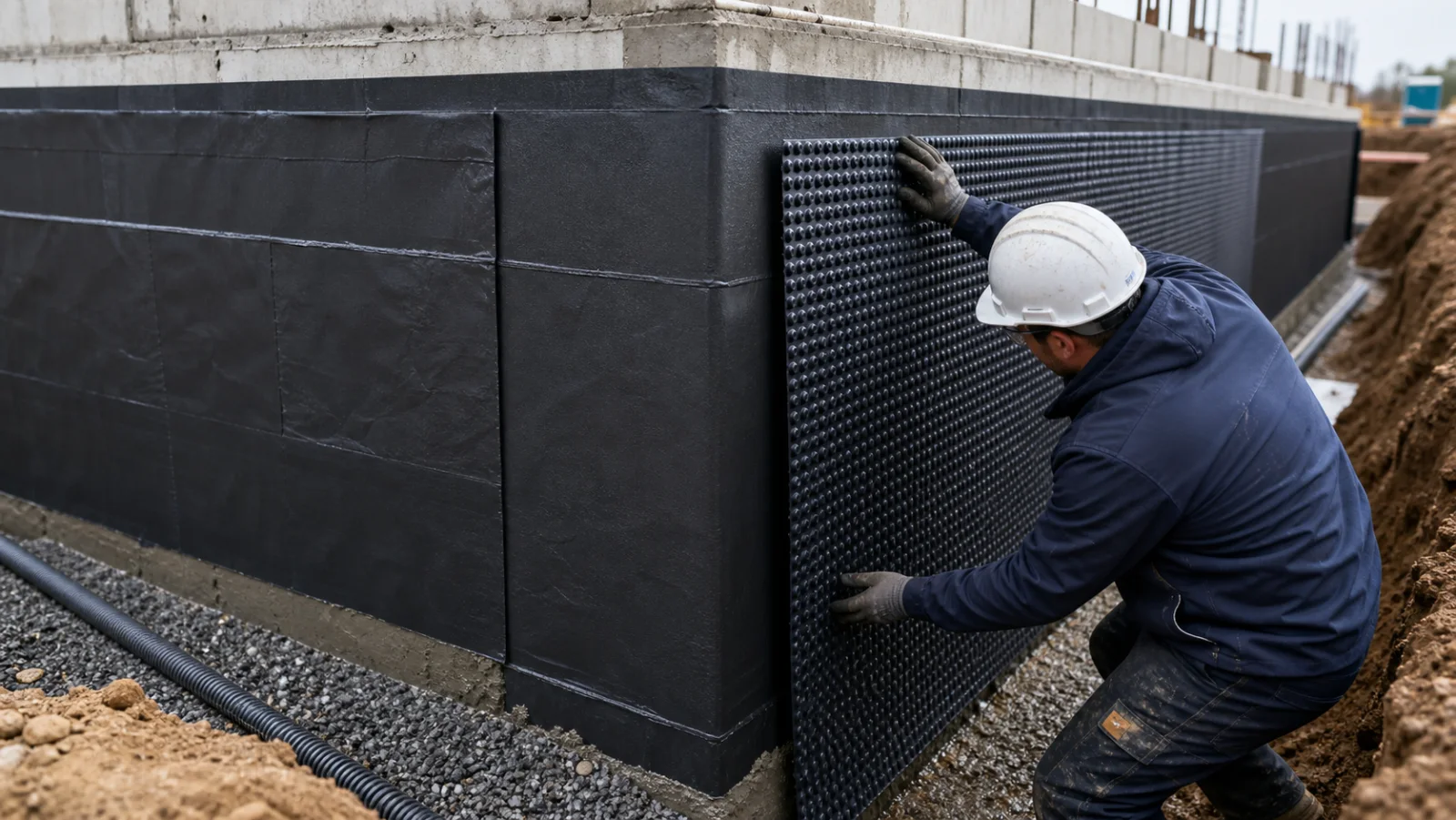
Foundation waterproofing aims to stop water outside before it enters the structure. This is positive-side waterproofing and external application to foundation/wall surfaces is the priority for new buildings. Ground moisture, temporary water accumulation and continuous hydrostatic pressure are different loads; select product and thickness according to ground investigation and project conditions.
Bitumen-based waterproofing is common on ground-contact foundations and walls. Weber Dry 706 Plus is a bitumen-based product for this application. After drying, suitable protection boards prevent backfill damage, and drainage layers carry water away from the structure.
Repair tie holes, construction joints, fillets and foundation-to-wall junctions before coating the main surface. Internal negative-pressure waterproofing may be considered for repairs where external access is impossible, but does not stop external exposure. Even with products declared suitable for positive and negative pressure, such as Weber Dry 2K CRS, assess substrate, pressure level and structural cracks separately.
Waterproofing Selection Matrix by Area
| Area | Product group to consider first | Essential system detail |
|---|---|---|
| Bathroom and shower | Flexible cement-based or under-finish liquid waterproofing | Corner tape, pipe collars, drain flange and under-tile continuity |
| Tiled terrace | Flexible liquid waterproofing suitable outdoors beneath finishes | Falls, parapet turn-ups, expansion joints and outdoor finish system |
| Exposed terrace or roof | Elastic cement, liquid or polyurethane system with declared UV resistance | Suitable primer, dry film thickness, UV/topcoat and service loads |
| Foundation and retaining wall | Bitumen, bitumen-polyurethane, cement or sheet membrane suitable for water loading | Positive-side continuity, protection board and drainage |
| Pool and water tank | System declared suitable for continuous immersion and intended use | Joints, water pressure, finish compatibility and drinking-water approval where needed |
What Roles Do Weber Products Perform?
- Weber Superflex D 24: Flexible cement-based waterproofing beneath tiles in wet areas, balconies and terraces.
- Weber Dry UV Coat: Elastic UV- and light-foot-traffic-resistant layer for exposed terraces and balconies.
- Weber Dry FDF Plus: Ready-to-use elastomeric liquid membrane for highly detailed surfaces such as roofs, gutters, chimneys and parapets.
- Weber PUR Seal 2K: Two-component polyurethane waterproofing for terraces, pools, tanks and wet areas according to project conditions.
- Weber Dry 706 Plus: Bitumen-based protection for foundations, basements and ground-contact retaining walls.
- Weber Dry 2K CRS: Crystalline cement-based waterproofing for positive/negative pressure on concrete and mineral surfaces; unsuitable for terraces and roofs.
- Weber Dry Rapid Stop: Repair product for rapidly stopping active local leaks; not a replacement for full-surface waterproofing.
How Are Consumption and Material Quantities Calculated?
There is no universal consumption figure per square metre. Product density, total dry film thickness, substrate roughness, water pressure class and reinforcement mesh requirements affect consumption. Calculate using the current data sheet's consumption for the selected application.
Add parapet and wall turn-ups, drain surrounds and overlaps to the net surface area. Repair defects with suitable mortar rather than filling them with the main waterproofing product; this makes film thickness and consumption easier to control. Do not alter two-component pack ratios, and mix only what can be used within the working time.
Common Waterproofing Mistakes
- Selecting by price or the name “liquid membrane” rather than application
- Assuming tiles and grout provide waterproofing
- Failing to check substrate moisture, adhesion and primer requirements
- Treating corners, drains, pipe penetrations and expansion joints like the main surface
- Applying one thick coat in breach of coat counts and waiting times
- Leaving a non-UV-resistant product unprotected on an exposed terrace
- Leaving foundation waterproofing without protection boards against backfill
- Mistaking leak-plugging repair mortar for a permanent full-surface system
Frequently Asked Questions
What is the best waterproofing material?
No single material is best for every application. Bathrooms, exposed terraces, foundations and water tanks have different water loads and substrates. Select by application, pressure, UV, traffic, substrate and subsequent finish.
Do bathroom tiles provide waterproofing alone?
No. Tiles and grout are finishes; water can pass through joints and cracks that develop over time. Continuous under-tile waterproofing, corner tape, pipe collars and drain details are required.
Which product should be used on an exposed terrace?
Select an elastic system with manufacturer-declared suitability for exposed terraces and UV resistance. Where there is foot traffic, verify the main waterproofing, topcoat, slip resistance and traffic resistance as a complete system.
Are foundations waterproofed internally or externally?
For new buildings, prioritise external positive-side application that stops water before entering the structure. Internal negative-side treatment is mostly considered for repairs with no external access, subject to project assessment.
Can an active leak be covered directly with liquid waterproofing?
First stop pressurised active leaks locally with suitable rapid water-plugging mortar and prepare the substrate. Then apply the main waterproofing system suitable for the water load over the entire area.
Conclusion: Correct waterproofing selection starts with substrate and exposure conditions rather than the area name alone. Prioritise under-tile detail continuity in bathrooms, falls and UV resistance on terraces, and positive-side waterproofing with mechanical protection at foundations. Compare waterproofing products and obtain technical support from Erk İzolasyon for a system suited to your substrate, use and installation conditions.